
According to recent market research commissioned by wellbeing expert Waldon among Belgian employers, HR professionals and employees, wellbeing is high on the agenda, but many organisations still struggle to translate their ambitions into meaningful, accessible support. One finding stands out in particular: when it comes to wellbeing initiatives, hybrid solutions are increasingly emerging as the preferred approach.
Technology creates opportunities, but not the complete answer
The rapid evolution of workplace technology is reshaping how organisations approach employee wellbeing. From ergonomic tools and wearable devices to wellbeing platforms, coaching apps and AI-powered support, employers today have more resources than ever to support their workforce.
The question is: is technology alone enough?
Waldon’s market research shows that both HR professionals and employees see value in digital wellbeing solutions. According to 68 percent of the HR respondents, digital tools can increase accessibility, provide personalised support and help organisations reach employees regardless of where they work. This is particularly relevant in hybrid work environments, where employees are no longer gathered in one physical location. At the same time, the research reveals an important nuance. While digital tools can support wellbeing initiatives, they cannot replace the human factors that have a big impact on employee wellbeing
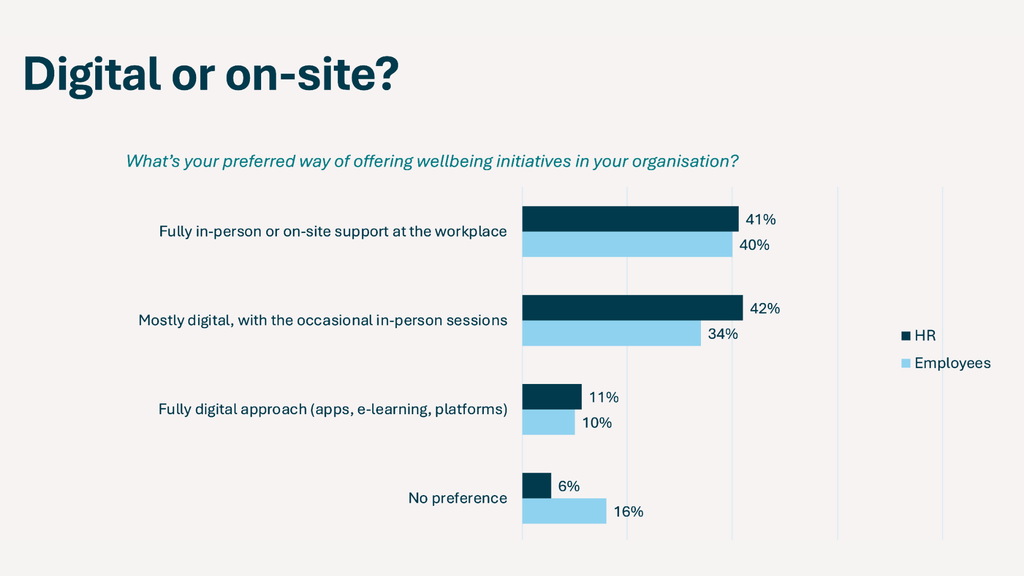
In other words, technology should be viewed as an enabler rather than a solution in itself. Organisations that combine digital wellbeing tools with genuine human connection, strong leadership and attention to workplace culture are more likely to create a lasting impact.
For HR leaders, this means the discussion is no longer about whether to use technology for wellbeing, but how to integrate it in a way that strengthens rather than replaces the human side of work.
Curious to discover more evidence-based insights into how technology and wellbeing can strengthen one another? Join Waldon’s annual (Dutch) wellbeing event on 27 October, where leading researchers such as Dr. William Fleming (Oxford University) and practitioners will share the latest insights, practical examples and strategies for creating wellbeing initiatives that truly make an impact.[VL1]
How Waldon brings hybrid wellbeing to life
For Waldon, these findings reinforce a simple principle: wellbeing support works best when people can access it in different ways, depending on their needs, preferences and working context.
That is why they combine human and digital support in their hybrid wellbeing journeys. Employees participate in workshops, coaching, webinars and other live interventions, which are complemented by a digital platform offering scientifically grounded content, self-assessments, videos, podcasts and practical tools.
This combination helps bridge a common challenge identified in the research: making wellbeing both accessible and relevant. Digital tools provide flexibility and support at the moment employees need it, while face-to-face interactions create connection, reflection and behavioural change.
For organisations looking to move beyond isolated wellbeing initiatives, a hybrid model offers the best of both worlds: the accessibility of technology and the impact of human interaction.