
Learning Bytes Festival is a one-day experience full of thought-provoking ‘learning bites’ aimed at inspiring you for the digital transformation of your L&D, HR, and talent development strategy.
It is an initiative from imec and Edtech Station, and its current, 5th edition takes place at HRTech Unfolded.
The festival showcases the latest insights from digital learning, AI, and workplace innovation, bringing together researchers, innovators, and practitioners to explore how people and organisations learn in a rapidly changing world.
This edition’s theme is ‘Learning technologies in critical times’. Today’s complex world puts our human capital under constant pressure, among other through the fast adoption of AI in our work environments. This year, therefore, the conference seeks to answer the question how enabling technologies like AI and XR can be developed and deployed responsibly, critically, and effectively in Learning & Development.

10:30 – 10:35
Main Room
WELCOME TO LEARNING BYTES FESTIVAL 2026
Join us for the official opening of this year’s Learning Bytes Festival as our hosts, Frederik Cornillie and Thomas Van Cauwenberghe, welcome you and guide you through a day filled with inspiring keynotes, engaging sessions and valuable opportunities to connect with fellow learning professionals.

Frederik Cornillie
Research and valorization manager at imec & KU Leuven
Frederik Cornillie (Ph.D., KU Leuven) is research and valorization manager at Itec, an interdisciplinary research group of KU Leuven and the strategic research institute imec in Belgium. Deeply passionate about research-based innovation in technologies for education, training, and learning, Frederik has spent over two decades bridging the gap between academic insights and real-world educational tools. He works at the forefront of the EdTech ecosystem in Flanders, championing effective collaboration models between researchers, startups, and organizations. He is dedicated to ensuring that as AI and emerging technologies reshape the future of work, the tools we build are scientifically grounded, scalable, and deeply human-centered. Frederik is heavily involved in imec’s strategic research programme on AI-driven education and training, in the EdTech-focused research in the Flanders AI Research programme, and in the incubation and strategy formation of EdTech Station. In 2022, he initiated Learning Bytes Festival and has been the driving force behind its scientific programme since then.
Frederik Cornillie

Thomas Van Cauwenberghe
Thomas Van Cauwenberghe is a dynamic opinion leader in the field of educational technology, currently serving as the Station Chief of <edtech/station>. With a strong experience in the edu-market and a commitment to innovation and development for over 20 years, Thomas has been instrumental in bringing together businesses, researchers, schools and L&D departments to collaborate on new learning technologies these last years around the Belgian ecosystem. Under his leadership, <edtech/station> has gathered a significant portion of the Belgian EdTech market, with over 350 active companies, 150 of which are now members receiving active support, information, and guidance. This initiative has fostered a collaborative environment where companies no longer operate in isolation but work together towards common goals. This vision extends beyond Belgium. <edtech/station> has been organising national and international events, inviting experts from countries around the world to discuss the challenges and opportunities in the EdTech landscape.
Thomas Van Cauwenberghe
10:35 – 11:10
Main Room
Opening keynote

Stijn Van Laer
Operational by design: What high-stakes environments teach us about learning and development
Stijn holds a PhD in Instructional Psychology and Pedagogy from KU Leuven. Over the past decade, he has designed and managed learning systems in environments where getting it wrong carries real consequences. At Mastercard, leading learning strategy for a global customer education academy across markets and jurisdictions; at NATO, heading the Learning Technologies Section and serving as Deputy Branch Head for Modelling, Simulation, and Learning Technologies; and now at ESHRE, overseeing education, certification, and accreditation for reproductive healthcare specialists across Europe and beyond. Three very different worlds. One conviction: learning and development only works when it is designed into operations, not just an afterthought.
Stijn Van Laer
Operational by design: What high-stakes environments teach us about learning and development
What if the biggest risk to our organisations isn’t whether our people are trained, but whether we are ready when it matters most?
Continued globalisation, artificial intelligence, geopolitical volatility, and accelerating skills obsolescence have further eroded the distance between training and performance. Yet many organizations still treat learning as a scheduled event rather than an operational necessity. In critical environments, this gap isn’t a pedagogical inconvenience, it’s a strategic liability. So what can a military alliance, a fintech, and a medical credentialing body teach us about closing it?
This keynote draws on experiences from three very different operational contexts and the research that supports them to answer those questions and surface one shared design principle: the organisations that perform best when it matters aren’t the ones with the best learning management system or content. They are the ones that have built learning into the architecture of how they operate.
You will leave this talk with concrete principles to bring back to your team, and sharper questions about your own organisation to take the thinking further.
11:10 – 11:35
Main Room
Research talk

Niko Verhaegen
From training to competency intelligence: how AI and XR transform workforce development in the semiconductor industry
Niko Verhaegen is an XR & AI innovation lead specializing in the future of workforce learning. Teaching and knowledge sharing have always been in his DNA, and for more than 25 years he has helped organizations transform the way people learn. At imec, he leads the development of XR programs that transform technical training into data-driven competency development. His human-centred vision keeps AI in the loop. Previously, he introduced VR learning on a global scale at GF Piping Systems.
Niko Verhaegen

Brian G. Booth
From training to competency intelligence: how AI and XR transform workforce development in the semiconductor industry
Brian G. Booth is a senior researcher in the imec image processing and interpretation lab, an embedded imec research group at Ghent University. He received a Ph.D. in computing science from Simon Fraser University before joining imec in 2016. He became a Marie Curie fellow in 2017 for his research in plantar pressure imaging. His current research focuses on industrial computer vision, specifically the challenges that arise when taking computer vision concepts from the lab to the real world. These challenges include vision-based understanding of the environment, like that of a trainee at a company, to improve user-machine interactions.
Brian G. Booth
From training to competency intelligence: how AI and XR transform workforce development in the semiconductor industry
The way we train people on-the-job has hardly changed in decades, yet the complexity of today’s workplace continues to grow. Companies are no longer challenged to just train people faster, but to understand how they learn, where they struggle, how to preserve critical knowledge, and how to continuously develop competencies while putting employees and trainers in the centre. Many industries are impacted by these trends, in particular high-tech sectors like advanced manufacturing, pharmaceutical engineering, and the semiconductor industry
In this session, we will show how imec’s strategic research programme on learning and training is laying the foundations of future workforce development in the semiconductor industry and beyond. It combines XR, AI and state-of-the-art sensing techniques to shed light on learning behaviour of engineers in training and capture tacit knowledge of experts with a view to developing a future-proof workforce in high-tech industries. We show how training in imec’s cleanroom is being transformed by adaptive educational technologies and competency assessment grounded in learning science, and how we are building new systems to preserve tacit knowledge of experts in order to make it available whenever and wherever it is needed. Our research will inspire you to help your organization reduce knowledge loss, accelerate onboarding and improve resilience against workforce turnover.
11:35 – 12:00
Main Room
Industry talk

Irina Cavescu
Irina Cavescu is a learning and product strategist passionate about what makes us human at work, and how strong interpersonal relationships can drive better business results, individual and organizational wellbeing, and more meaningful ways of working. As Head of Portfolio at Learnlight, she leads global portfolio strategy across interpersonal, intercultural, and language skills, helping organizations build the capabilities people need to perform and collaborate in an increasingly complex world of work.
Over the course of her career, Irina has moved from teaching and language education into the heart of global business, supporting international teams and organizations through periods of growth, change, and transformation. Her background in the humanities and intercultural communication, paired with years of experience across learning, global mobility, client success, and product leadership, gives her a distinctive perspective on how human capabilities translate into business outcomes.
Today, Irina focuses on turning learning and human skills into measurable business impact, with a particular interest in how AI is reshaping the way people work, learn, communicate, and connect, and what that means for the future of work.
Irina Cavescu
Human(e) communication in the age of chatbots
AI increasingly translates, writes, and even speaks for us. Therefore, we need to rethink language training, considering critically what effective communication means, what people still need to learn, and how. Because communication has never been about producing the right words alone. It is about interpreting, adapting, navigating cultural differences and connecting with other people.
In this talk, we recognize that AI is transforming our use of language on the job as well as language training – much like it is transforming other domains of work and L&D – and that it challenges us to critically re-assess what language training should be like. We explore the broader spectrum of communication capability: from language skills to intercultural competence and interpersonal skills. We will consider what AI can augment, what we may not want to outsource, and why human interaction itself remains an essential part of learning. Participants will leave with three questions to help them decide what technology should do for their people, and what they still want their people to be able to do for themselves and for each other.
13:30 – 13:55
Main Room
Panel: AI, skills and the future of work: foes or friends?

Griet Holsbeek
Griet Holsbeek holds a PhD in Biology and is Manager of the FAB Training Center at imec. Drawing on experience in quality, training effectiveness and project management in production environments, she aims to develop scalable learning approaches that keep pace with rapid technological and operational change. Together with her team, she has built structured training plans, strengthened trainer capability, established a dedicated FAB Training Center, accelerated learning without compromising quality by introducing XR-based training using virtual and augmented reality. Her work focuses on turning critical operational knowledge into accessible, effective learning and support that helps people and boost performance in high-change environments.
Griet Holsbeek
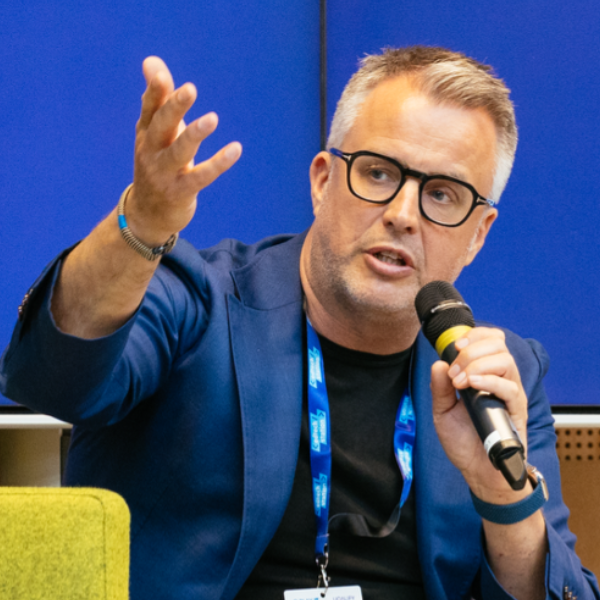
Thierry Lescrauwaet
Thierry Lescrauwaet is CEO of UQ Learn and Zaia, a Board Member of Federgon, and member of the advisory board for the EU Digital Skills and Jobs ecosystem. With over two decades of experience in organizational development and digital transformation, he helps organizations turn their expertise into a strategic asset. Thierry is the driving force behind the eXpertise Stack vision: activating, capturing, and sharing knowledge to connect people and build a culture of collective growth. His core belief is that the future of work is a team sport, and should be inclusive by design. As AI advances and complexity increases, organizations need more human expertise, connection, validation, and personal contribution, not less. Through Zaia’s human-first approach to AI, Thierry focuses on keeping people in the lead while using technology as an enabler.
Thierry Lescrauwaet

Mikkel Barslund
Mikkel Barslund is Senior Research Manager at HIVA–KU Leuven, the Research Institute for Work and Society. He works on how structural changes – technology, demographics and the green transition – are influencing European labour markets. With more than two decades of research and policy experience, his expertise spans skills, labour shortages and job quality. His current work examines how AI and the green transition affect jobs, working conditions and opportunities for workers at different stages of their careers. He brings an evidence-based perspective to debates on the future of work, including how lifelong learning and skills development can help workers and organisations adapt to change.
Mikkel Barslund
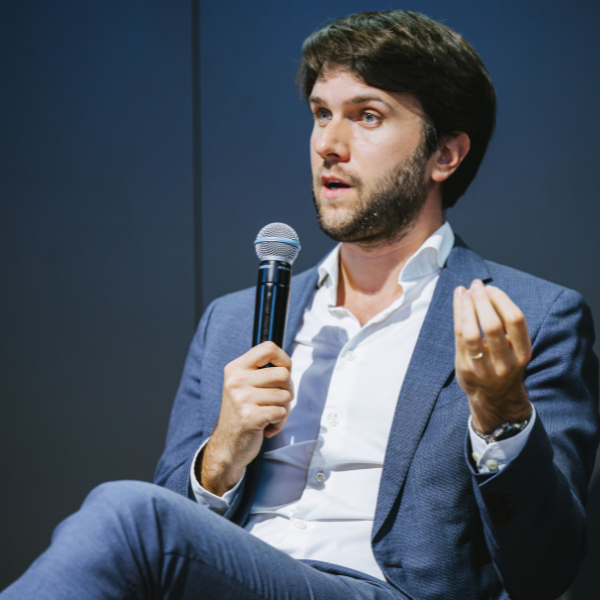
Maurits Vanackere
Maurits Vanackere is Co-Director Flanders and Legal & Policy Advisor at Federgon, the Belgian federation of HR service providers. He specialises in labour market policy, employment regulation and lifelong learning. His focus is on helping organisations navigate regulatory change while contributing to a more dynamic, inclusive and future-oriented labour market. Working closely with member companies, governments and social partners, he helps shape policies and solutions that support workforce development, skills transformation and labour market participation. His work focuses on enabling organisations and individuals to adapt successfully to technological, demographic and economic change.
Maurits Vanackere
Frederik Cornillie
Research and valorization manager at imec & KU Leuven
Frederik Cornillie (Ph.D., KU Leuven) is research and valorization manager at Itec, an interdisciplinary research group of KU Leuven and the strategic research institute imec in Belgium. Deeply passionate about research-based innovation in technologies for education, training, and learning, Frederik has spent over two decades bridging the gap between academic insights and real-world educational tools. He works at the forefront of the EdTech ecosystem in Flanders, championing effective collaboration models between researchers, startups, and organizations. He is dedicated to ensuring that as AI and emerging technologies reshape the future of work, the tools we build are scientifically grounded, scalable, and deeply human-centered. Frederik is heavily involved in imec’s strategic research programme on AI-driven education and training, in the EdTech-focused research in the Flanders AI Research programme, and in the incubation and strategy formation of EdTech Station. In 2022, he initiated Learning Bytes Festival and has been the driving force behind its scientific programme since then.
Frederik Cornillie
13:55 – 14:20
Main Room
Research talk

Klaas Bombeke
Adaptive cognitive load assessment in healthcare training and beyond
Klaas Bombeke has a background in experimental psychology and cognitive neuroscience research and is a senior researcher at the imec-mict-UGent research group and operational manager of the imec-affiliated EMU Lab (www.emulab.eu). In his research, he brings together methods and theories from engineering, psychology, neuroscience, and communication sciences to study, create, and improve human-technology interactions. His work focuses primarily on the design of electronic and digital products, with particular attention to psychophysiology, (neuro)ergonomics, objective and implicit measures of user experience, and psychological phenomena such as stress, mental effort, attention, and other cognitive-affective states. In December 2024, he co-founded the spin-off ‘Spatial Dynamics’ together with colleagues, an initiative of imec, Ghent University, and Howest, where they build generic VR-based assessments for the workforce of tomorrow (www.spatialdynamics.eu). There, he is currently mainly involved in developing competence measurements based on behavioral data captured in VR1.
Klaas Bombeke
Adaptive cognitive load assessment in healthcare training and beyond
Timing is everything in training: support that comes too early interrupts productive struggle and breeds over-reliance, while support that comes too late leads to frustration and disengagement. Yet most training systems today are blind to the learner’s internal state: they only see errors and completion times, long after the optimal moment for intervention has passed. In high-stakes domains such as healthcare, where professionals must learn complex procedures under pressure, this inability to sense when a learner is struggling (but not yet asking for help) represents a major missed opportunity for both learning efficiency and patient safety. In this session, I will show how immersive technologies like VR, combined with multimodal behavioral and physiological sensing, allow us to assess cognitive load and anticipate learner needs in real time. Drawing on recent research from our lab, I will demonstrate how subtle nonverbal signals — gaze patterns, head movements, and hand kinematics — can predict that a trainee is about to seek help several seconds before they actually ask, and how machine learning models trained on human delegation decisions can determine when to increase or decrease assistance, bridging the gap between adaptive (system-controlled) and adaptable (user-controlled) support.
14:00- 14:30
Breakoutroom: Data & Performance Management
Research talk

Ben De Meester
Ben De Meester is a post-doctoral researcher in the KNoWS research group at IDLab, Ghent University & imec, where he conducts research on semantic and technical interoperability across European, national, and industrial R&D projects. As one of the leads behind RML.io and FnO, he develops methods and technologies that enable organisations to transform heterogeneous data into interoperable Knowledge Graphs and data-driven applications. His work spans Linked Data, Solid, Verifiable Credentials, and data exchange architectures, with a focus on enabling secure, reliable, and scalable information sharing across organisational boundaries. Through collaborations with industry, government, and academia, he helps bridge the gap between cutting-edge research and practical interoperability solutions.
Ben De Meester

Brecht Wyns
Brecht Wyns helps organisations unlock the full potential of data for businesses and governments, while respecting people’s rights over their personal data. A Business Engineer from Solvay Brussels School, he has worked in data governance since 2012 (PwC, Colruyt Group). Driven by a passion for personal data empowerment, he joined Inrupt to work with Sir Tim Berners-Lee on bringing personal data vault technology to enterprises. Today, at Athumi, he continues that mission: enabling trusted, consent-based data exchange between citizens, organisations and governments.
Brecht Wyns
Your data, their decision: personal data exchange through data spaces
Data spaces give organisations shared European infrastructure to find and exchange data under common rules. For HR, this means less paperwork, more efficient processes and better hiring decisions based on verified information. But HR runs on personal data such as diplomas and skills, and GDPR protects that data strictly. For data spaces to deliver their full value in HR, personal data has to be able to flow too, and only with the consent of the person it belongs to.
Athumi and imec are building exactly that. In this session, we explain what EU Data Spaces can do for HR and we show how Flanders’ trusted data ecosystem connects to the European Skills Data Space, built on Prometheus-X, so personal data such as official student enrolment status can be discovered and shared across Europe. You will leave with a clear understanding of data spaces, why consent-based exchange of personal data is the key to unlocking them, and how this approach can serve as a blueprint for data sharing with people and businesses.
14:20 – 14:55
Main Room
Closing keynote

Bien Vanderstappen
Bien Vanderstappen is CEO and co-founder of TEO, a scale-up that helps the manufacturing industry discover, develop, and retain technical talent. Driven by her belief that the shortage of technical profiles cannot be solved simply by searching for talent, but by creating it, she is building innovative solutions at TEO for upskilling, assessments, and knowledge retention on the work floor.
With more than ten years of experience in recruitment and talent development, Bien combines a strong professional background with a deep passion for education, technology, and industrial innovation. She challenges organisations to look beyond CVs and diplomas and focus on people’s potential to grow. This vision is the common thread running through both her entrepreneurship and TEO’s mission.
As a speaker and entrepreneur, she inspires organisations to stop viewing talent development solely as an HR challenge and instead recognise it as a key driver of sustainable growth and competitiveness.
Bien Vanderstappen
The CAPEX mindset in L&D: why human-centric learning technologies are your smartest investment
We insure our machines. We maintain our technology and depreciate our assets.
But when it comes to people, we suddenly call it a training budget. Or worse, a training cost.We know the loss of a minute of machine downtime, but rarely have a clue what the cost of a missing skill is.
We invest millions in automation, then act surprised when our people can’t keep up.
We call our employees our greatest asset, then underinvest in the skills that make them valuable. We keep treating their capabilities like an optional expense.
That isn’t just inconsistent. It’s poor economics.
Because technology doesn’t create value. People who can master technology do.
So stop asking, “What does learning cost?”
Because the most expensive asset in your factory may not be the machine you fail to maintain, but the human standing right next to it.
14:55 – 15:00
Main Room